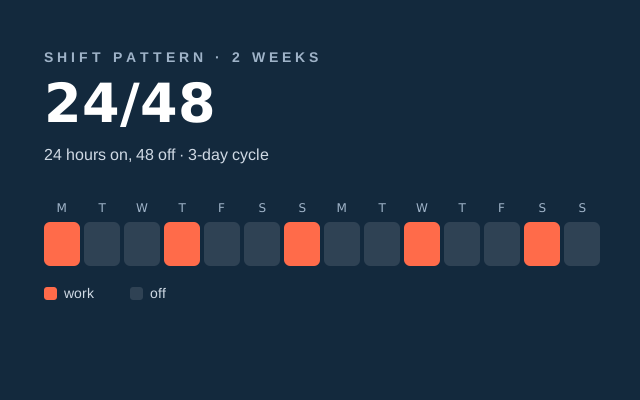
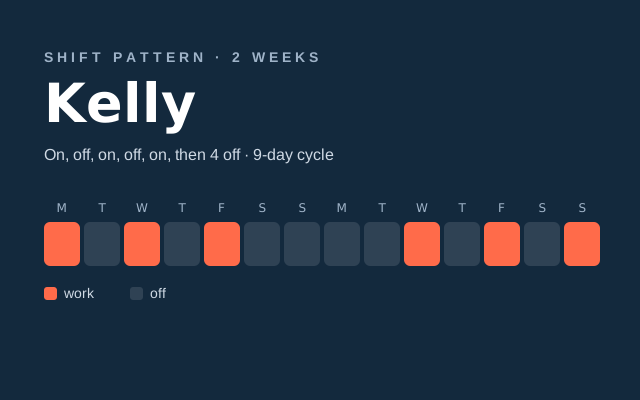
The 48/96 schedule is used by many fire departments: 48 hours on duty, then 96 hours off, on a 6-day cycle.
The pattern
| Day | 1 | 2 | 3 | 4 | 5 | 6 |
|---|---|---|---|---|---|---|
| Hours | 24 | 24 | off | off | off | off |
Hours
Over one 6-day cycle that is 48 hours, an average of 56 hours a week. Because the cycle does not line up with a calendar week, some weeks have more hours than others: the calendar above shows each week’s total and the hours over 40.
It averages 56 hours a week, which is why fire departments usually pay overtime on a longer work period under FLSA section 7(k).
Overtime
Under federal law, most hourly employees get overtime for hours over 40 in their employer’s fixed workweek, whatever the schedule. Fire and police departments can use a longer work period under section 7(k) of the FLSA; for fire protection that is 212 hours in 28 days. State rules and union contracts can add more.
Sources
- 29 CFR 553.230: maximum hours for fire protection and law enforcement work periods under FLSA section 7(k)
- US Department of Labor Fact Sheet 8: Law Enforcement and Fire Protection Employees Under the FLSA
Sources last checked 1 November 2026.
Frequently asked questions
How many hours is a 48/96?
48 hours every 6 days, an average of 56 hours a week.
Do firefighters get overtime on a 48/96?
Under FLSA 7(k), public fire departments can pay overtime after 212 hours in a 28-day work period. Many contracts set different rules.
What is the difference between 24/48 and 48/96?
Both average 56 hours a week. 48/96 groups shifts into two in a row with four days off.